
What Worked for Lake Trout, Smallmouth Bass & Pike in Ontario | Linn Creek Outdoors
Posted by Randal Zimmerman on Sep 22nd 2026
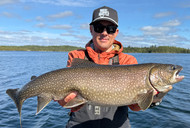
On a four-day fall trip to Lower Manitou Lake in Ontario, we caught lake trout, smallmouth bass and northern pike using the same basic presentation: a 1/2-ounce jig paired with a dark-bodied 4-inch paddle tail.
We caught lake trout in 80–100 feet of water and smallmouth and pike in 10–20 feet. Instead of changing our entire setup for each species, we kept the presentation simple and adjusted where and how we fished it.
The Four Jigs We Used
We used four different 1/2-ounce Big Sky Jigs:
The Hecla Hammers provided a larger profile with additional flash and movement. The EyeCons gave us a cleaner presentation with a wire bait keeper that held the plastics securely.
All four jigs caught fish.
Wonderbread and Greenback gave us two contrasting Hecla Hammer options. Silver/Black provided a more natural baitfish look, while Black/Yellow/Orange gave us a darker, higher-contrast presentation.
That was enough variety to adjust without constantly changing tackle.
Why We Used 1/2 Ounce
A 1/2-ounce jig proved to be the most useful weight for the conditions.
It was heavy enough to reach lake trout in deep water while still giving us good control. In shallower water, it allowed us to fish quickly and maintain contact while targeting smallmouth and pike.
A heavier jig may have been useful in stronger wind. A lighter jig could have provided a slower fall in shallow water. For this trip, 1/2 ounce covered most of what we needed to do.
The 4-Inch Paddle Tails
We paired the jigs with dark-bodied 4-inch paddle tails from Z-Man and Fish Bum.
The 4-inch profile was large enough for lake trout and pike without being too large for smallmouth. It also paired well with the hook size and profile of the 1/2-ounce jigs.
We did not carry dozens of colors or continually rotate through different plastic styles. Once we found a size and general profile that worked, we stayed with it.
Fishing Deep for Lake Trout
Most of our lake trout fishing took place in approximately 80–100 feet of water.
At those depths, boat control mattered more than constantly changing color. The jig needed to reach the fish efficiently, stay where we could track it and allow us to respond when a lake trout moved toward the bait.
The 1/2-ounce jigs handled those depths under the conditions we had, although wind and boat movement can quickly make a heavier jig necessary.
The lake trout responded to both Hecla Hammers and EyeCons. That gave us two different presentations without requiring a major change in the setup.
Moving Shallow for Smallmouth and Pike
We used the same jig-and-plastic combinations when we moved into 10–20 feet of water.
Smallmouth bass and northern pike both responded to the 4-inch paddle tails. The presentation could be cast, allowed to fall and worked back through the water without changing rods or rebuilding the setup.
That versatility was the most useful lesson from the trip.
The same basic combination worked across nearly 90 feet of depth and for three different species. We changed location, retrieve and presentation angle more often than we changed tackle.
The Main Lesson
We caught three species in shallow and deep water with four jigs, one jig weight and one basic plastic profile.
That does not mean those exact combinations will be best every day on every Canadian Shield lake. Wind, light, water clarity and fish activity will always affect the presentation.
We still had to find the fish and put the bait in front of them. The tackle simply gave us a dependable presentation once we did.
We kept our colors and presentations simple, adjusted to the conditions and spent more time fishing than searching through the tackle box.