
How to Choose a Jig Color: Natural vs. Bright vs. Dark | Linn Creek Outdoors
Posted by Randal Zimmerman on Aug 27th 2026
Choosing jig color gets easier when you stop asking, “What is the best color?” and start asking, “What do the conditions call for?”
At Linn Creek Outdoors, we think about color as another adjustment.
Water clarity, light, depth, forage, and fish activity all affect how a jig looks underwater. The goal is not to carry every color available.
It is to carry colors that give you different options when conditions change.
Start With Water, Light, and Depth
Before choosing a jig color, look at three things:
- Water clarity
- Light conditions
- Depth
A color that looks perfect in bright sun and clear water may have much less definition in stained water or at depth.
That is why color should be matched to the conditions instead of chosen by habit.
Natural Colors — Start With Forage
Natural colors are usually where we start when visibility is good and fish have time to inspect the presentation.
Think whites, silvers, perch tones, baitfish patterns, and other colors that resemble what fish are already eating.
Natural colors make sense when:
- Water is clear
- Sunlight is strong
- Fish are feeding on visible forage
- Fish are neutral or pressured
- You want the jig to look believable rather than aggressive
Bright sun and clear water are often good conditions for a more natural presentation.
Bright Colors — Increase Visibility
Bright colors are useful when you want the presentation to stand out.
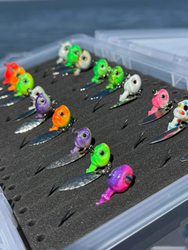
Chartreuse, orange, pink, and other high-visibility colors can help fish locate a jig when conditions reduce visibility or when fish are feeding aggressively.
We move toward brighter colors when:
- Water is stained
- Skies are overcast
- Light penetration is reduced
- Fish are active
- Natural colors are not producing
Bright does not automatically mean better.
It simply gives the fish a more visible target.
Dark Colors — Create Contrast
Dark colors solve a different problem.
Rather than trying to be brighter, they create silhouette and contrast.
Purple, black, and darker patterns can be effective when:
- Skies are overcast
- Light levels are low
- Water is stained
- You want a defined silhouette
- Bright colors are getting attention but not bites
That is why low-light conditions do not always mean choosing the brightest jig in the box.
Sometimes darker is the better adjustment.
What About Glow?
We think of glow as another visibility tool rather than a separate color category.
Glow can be useful in deeper water, stained water, low light, and ice-fishing situations where available light is limited.
Like flash, sound, or vibration, it should have a job.
Bright Sun vs. Overcast
Light conditions can change which colors make the most sense.
Bright sun + clear water → start natural or subtle.
Overcast conditions → consider more contrast.
Stained water → bright or dark colors can both create a stronger target.
Deep water or low light → glow, dark silhouettes, or high-contrast patterns become more useful.
These are starting points, not hard rules.
Contrast Patterns Give You Another Adjustment
Some effective jig colors do not fit neatly into natural, bright, or dark.
They combine those jobs.
A natural base with a bright accent. A dark back with a glow belly. A white jig with strong contrasting colors.
Patterns like Wonderbread work because they give fish multiple visual cues rather than relying on one solid color.
A Simple Way to Start
Bright sun + clear water → natural
Overcast → more contrast
Stained water → bright or dark
Deep water / low light → glow, dark, or high contrast
Aggressive fish → do not be afraid to get brighter
Fish seeing the jig but not committing → change the look
The fish always get the final vote.
How LCO Builds Color Coverage
At Linn Creek Outdoors, we do not think a good jig selection means carrying every available color.
We think it means having colors that solve different problems.
Across our Jig Systems, we build around five basic visual jobs:
Natural / Forage-Based
Whites, silvers, perch tones, and baitfish-style patterns give you a believable starting point when water is clear and fish can inspect the presentation.
Bright / High-Visibility
Pink, orange, chartreuse, and other attractor colors give you another gear when visibility drops or you want the jig to stand out.
Dark / Contrast
Purple, black, and darker-backed patterns give you silhouette when contrast matters more than brightness.
Glow
Glow gives you another visibility option for deeper water, low light, stained water, and ice-fishing conditions.
High-Contrast Patterns
Patterns that combine natural, bright, dark, or glow elements can give fish multiple visual cues in one presentation.
That is why you will see this range repeated across the jig systems we carry.
The point is not color variety for its own sake.
The point is coverage.
For anglers who do not want to build that coverage one jig at a time, our Trip Ready Systems use the same logic.
We select colors, weights, plastics, and presentations to give the angler useful adjustments for the conditions that are most likely to change.
That is the difference between a color collection and a color system.
Let the Fish Override the Theory
Color theories are useful until the fish disagree.
If a natural color is producing in dirty water, keep fishing it.
If bright pink is working in clear water under full sun, do not change it because a chart says you should.
The purpose of a color system is not to predict every bite.
It is to give you logical adjustments when you are not getting bites.
Final Thought
There is no single best jig color.
There is a best starting point for the conditions you are fishing.
Start with the water.
Look at the light.
Consider the depth.
Then choose whether the fish need something natural, brighter, darker, glowing, or simply different.
You do not need every color.
You need enough different looks to make the next adjustment.
That is how we think about jig color at Linn Creek Outdoors.
Gear You Trust When It Matters.